Storing stability: the new backbone of the Baltic grid
By Elīna Neimane, Senior Communications Officer, NIB
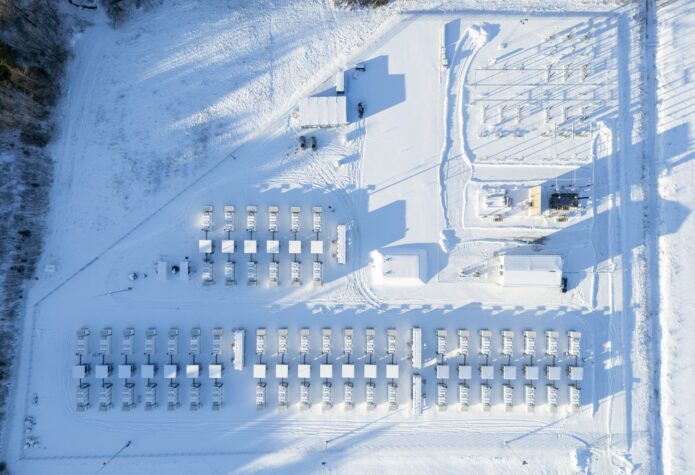
In an open field in Kiisa, just 25 kilometres south of Tallinn, rows of container-sized battery units stand aligned with quiet precision. A fence surrounds the equipment – nothing dramatic. Yet inside these units, a fundamental shift in the Baltic electricity system is taking shape.
Hertz 1, one of the region’s newest large-scale battery parks, represents more than a technological upgrade. It reflects a structural transformation in how electricity systems are designed, operated and stabilised.
The energy transition is often framed around generation – more wind, more solar, more renewables. But as the Baltic states expand renewable capacity and complete synchronization with continental Europe, a new priority has emerged ensuring that increasingly variable systems remain stable, resilient and economically efficient.
A system built for yesterday
For decades, electricity systems were built around predictable, controllable generation. Large power plants – gas, coal or oil shale – produced steady output. Grid operators could adjust supply to match demand with relative ease.
Today, the picture is fundamentally different. Wind and solar capacity have expanded rapidly across Europe and in the Baltics. By the end of 2025, total installed wind and solar capacity across the Baltic states is expected to reach almost 9 GW, compared with just 1 GW in 2021, according to ENTSO-E data.
Renewable energy is clean and increasingly affordable – but it is also variable. The sun shines when it shines. The wind blows when it blows. Not necessarily when the system needs electricity most.
At the same time, geopolitical developments have sharpened the focus on energy security. Following synchronisation with the Continental European grid in 2025, responsibility for maintaining system frequency and stability now rests fully within the region. As Erkki Sapp, Member of the Management Board at Estonia’s transmission system operator Elering, puts it:

Power systems of the future face two main challenges: short-term flexibility and adequacy during low renewable generation periods. Short-term variability requires assets that can react within seconds. When it comes to stabilising the grid moment by moment, speed matters. That is where batteries come in.
Erkki Sapp
Member of the Management Board at Elering
Why batteries – and why now?
A decade ago, large-scale battery storage was still considered niche. Today, it is increasingly treated as essential infrastructure. According to Karl-Joonatan Kvell, CEO of renewable energy developer Evecon, several structural developments have converged in a short period of time.
The rapid growth of variable renewables has increased the need for flexibility. Battery technology has matured and become more cost-efficient. And the Baltic states’ transition away from the BRELL system – the Soviet-era electricity synchronisation agreement linking Belarus, Russia, Estonia, Latvia and Lithuania – has heightened awareness of system-level risks.

All these factors emerged within just a few years. As renewable generation increases, we need flexible assets to move at the same speed. In practical terms, batteries help solve the timing challenge of renewables. They balance supply and demand on a second-to-minute timescale, provide frequency and voltage control, and enable higher renewable penetration without compromising grid stability.
Karl-Joonatan Kvell
CEO of Evecon
What happens when the grid becomes unstable?
Electricity systems across Europe operate at a frequency of 50 hertz. Frequency reflects the balance between generation and consumption. If it drops, demand exceeds supply. If it rises, supply exceeds demand. Any imbalance must be corrected immediately to avoid disruptions. “Batteries are flexible and can react almost instantly,” says Sapp. “They can push power into the system or absorb it within seconds. That quick response helps solve problems early and improves resilience to interruptions.”
If solar production drops suddenly due to cloud cover, or a large generator trips offline, battery systems can inject power within milliseconds – stabilising the system while slower assets respond. Traditional power plants remain important, particularly during prolonged low-renewable periods. But for rapid frequency reserves, batteries are uniquely suited.
The Baltic dimension: small grid, big stakes
For smaller and relatively low-inertia systems like those in the Baltics, flexibility is particularly critical. Every megawatt of balancing capacity matters.
As Kvell notes, when variable renewables account for a growing share of generation, demand for balancing services rises sharply. Estonia has already experienced this effect. “In 2025 alone, we paid around EUR 74 million to maintain balance,” he says. “With significantly more flexible capacity, those costs could be dramatically lower.”
Synchronization with continental Europe introduced new operational principles and strengthened the importance of local reserve capacity. New markets for frequency reserves have emerged, creating the economic framework that makes investments in storage viable.
A practical example: Hertz 1 in Kiisa
Hertz 1 officially opened in Kiisa with 200 MWh of storage capacity, representing a significant addition to Baltic flexibility resources. The project also marks a technical first for Estonia: a high-voltage connection to the 330 kV transmission network via an underground cable, strengthening the resilience of its grid integration.
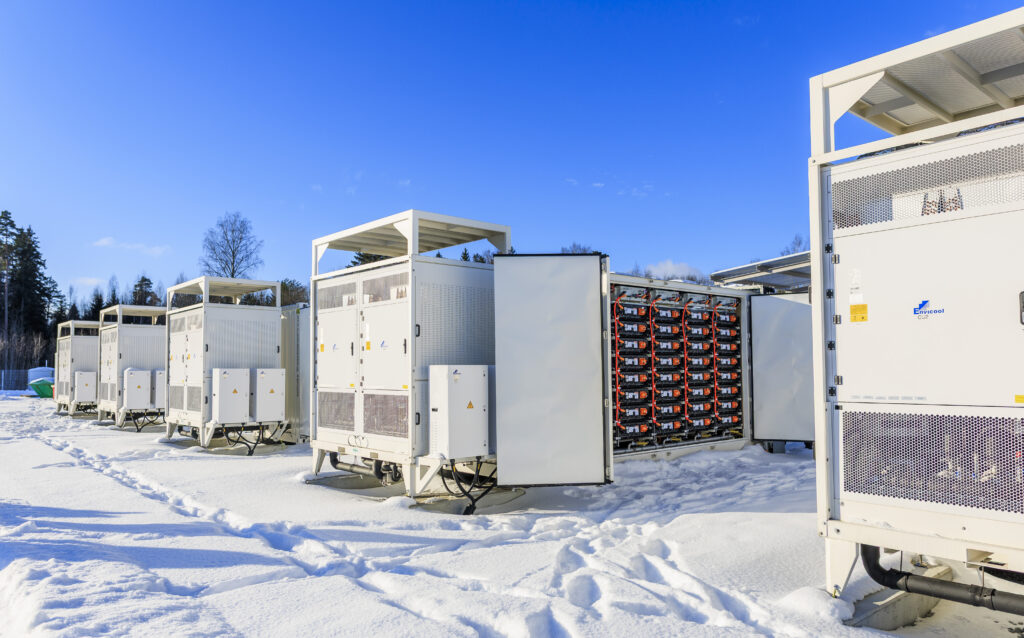
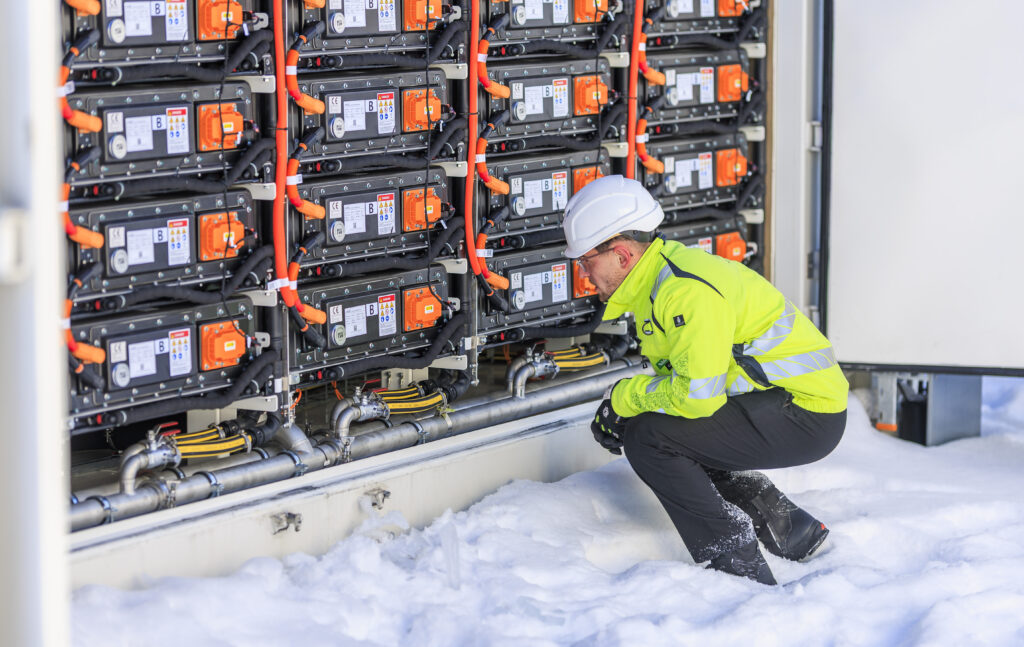
The facility consists of 54 containerised units housing 2,328 battery modules. Each unit integrates cooling, fire protection and monitoring systems, forming a secure and self-contained energy storage asset. Designed to provide rapid-response frequency reserves, the park can react within seconds to system imbalances.
Beyond stabilisation, storage increasingly supports market efficiency. By storing electricity when supply is abundant and releasing it during periods of higher demand, battery systems help reduce extreme price volatility and improve the overall balance between production and consumption.
“Hertz 1 is a critical piece of infrastructure that allows us to manage our energy sovereignty with confidence while accelerating the transition to clean, renewable energy,” says Kvell.
The project is being developed by the Baltic Storage Platform, a joint venture between leading Baltic renewable energy developer Evecon, French independent solar power producer Corsica Sole, and sustainable investment manager Mirova. Its financing is supported under the InvestEU programme through the Nordic Investment Bank’s Framework on Clean Energy Transition, highlighting the growing recognition of battery storage as essential energy infrastructure rather than a niche market asset.
What does this mean for consumers?
For households and businesses, the impact of battery storage may not always be visible – but it is tangible. By reducing short-term imbalances, storage helps limit extreme price spikes and lowers overall balancing costs. Over time, this supports a more predictable and resilient electricity market.
Batteries are not a silver bullet. They do not replace all generation assets or solve long-duration supply challenges. But as renewable penetration rises, they are becoming indispensable components of a stable electricity system.
What comes next?
While Hertz 1 has begun full operations, its sister project, Hertz 2 in Aruküla, is already under construction. Once both are completed, the combined capacity will reach 200 MW / 400 MWh, forming one of the most powerful battery complexes in Continental Europe.
Looking ahead, installed flexibility capacity in the Baltics is expected to grow significantly by 2030. The challenge is coordination: renewable expansion and balancing capacity must develop in parallel. Move too slowly, and system costs increase. Move too quickly without flexibility, and stability is compromised. The energy transition is entering a new phase. It is no longer defined solely by how much renewable capacity is installed, but by how reliably and efficiently the system operates as a whole. In that shift, storage is moving from the margins to the core of energy infrastructure policy in the Baltics.