Follow the green euro from investor to end user
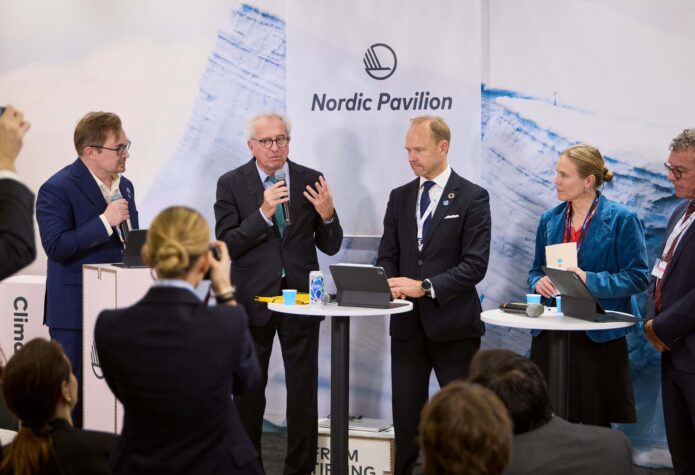
When an investor buys a green bond, the money can end up in a hydropower plant inside a Norwegian mountain or a biogas plant in Denmark. At COP31 in Antalya, NIB brought together different parts of the financing chain, from investor and lender to companies receiving NIB financing, to show how.
The session opened the finance afternoon at the Nordic Pavilion on 13 November. A green bond is a bond whose proceeds are set aside for projects that benefit the environment. The panel followed that money step by step.
The panel followed the money step by step, bringing together perspectives from Pierre Gramegna, Managing Director of the European Stability Mechanism (ESM); André Küüsvek, President and CEO of NIB; Elen Richter Alstadheim of Statkraft; and Michael Hannibal of Copenhagen Infrastructure Partners (CIP). NIB’s Jukka Ahonen, Chief Corporate Affairs Officer, moderated.
“A no-brainer”
The ESM was set up in 2012 to lend to euro area countries that had lost access to financial markets. It holds EUR 81 billion in paid-in capital and invests part of it in green and sustainable bonds. Those holdings reached EUR 7.5 billion last year, and Mr Gramegna expects close to EUR 10 billion this year.
He gave two reasons. Climate change is a long-term risk to the public finances the ESM is there to protect. And Europe has little oil and gas of its own.
“Going to renewable energy and electrifying our economies is a no-brainer,” he said.
The ESM does not give up returns to do this. Gramegna said it finds sustainable bonds that pay about the same as ordinary bonds, and sometimes more. What it needs is reliable information on where the money goes. NIB’s assessment and reporting give investors information on the projects behind the green bonds.
Long-term lending
NIB is owned by the eight Nordic and Baltic countries and has the highest possible credit rating. It borrows from investors such as the ESM, central banks, pension funds and asset managers. It raises funding from these investors and uses its balance sheet to provide long-term loans for projects.
Before lending, the Bank assesses each project’s environmental impact, risks, legal standing and governance. “Money will go where the good projects are happening,” Küüsvek said.
He pointed to the length of the loans as NIB’s main contribution. The Bank lent to the two biogas plants for 13 and 16 years, longer than commercial banks often offer on their own. NIB can also keep lending in a downturn, when others pull back.
Hydropower and biogas
Statkraft, owned by the Norwegian state, is Europe’s largest producer of renewable energy. NIB’s loan helps pay for the refurbishment and upgrade of hydropower plants in Norway. One is the Svean plant, which has run since 1939. The upgrade will raise its output from 120 to 150 gigawatt-hours.
Most of Statkraft’s financing is green, Alstadheim said. Borrowing from NIB also gives the company a wider group of investors to draw on.
CIP invests money from pension funds and other investors in renewable energy projects. Each project raises its own loans. NIB has lent to two biogas plants majority-owned by CIP, in Sindal and Tønder in Denmark.
Hannibal said NIB’s loan enabled the Sindal plant to expand and add a unit that liquefies captured CO2. He said locally produced biogas now accounts for about half of Denmark’s gas use.
The money is there, the grids are not
Asked what holds the green transition back, none of the panellists named a lack of money. “The money is definitely there,” Küüsvek said. He added that pension funds and sovereign wealth funds are now willing to take more risk.
The obstacles lie elsewhere. Hannibal said projects are delayed or cancelled because they cannot get a connection to the power grid. He called for public and private investors to share more of the risk in the early stages of a project.
Alstadheim listed what Statkraft needs from policymakers: grids, cross-border power links, faster permits, predictable policies and efficient power markets.
Gramegna said electrification and grids should be an absolute priority for the EU. Political will of that kind also brings in private capital, he said.
Karen Ellemann, Secretary General of the Nordic Council of Ministers, spoke from the audience. Trust and transparency are “the foundation to make this work”, she said. She will take the panel’s ideas to the Nordic ministers.
You can watch the discussion here.