Centralstaden in Gothenburg takes shape
In Gothenburg, a new central city district is taking shape in a previously underutilised area near the central station. The transformation begins with two buildings of the highest environmental rating, designed to handle the flow of passengers to and from Centralen Station in the new commuter rail tunnel, Västlänken.
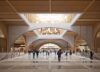
Stepping into the new station building in Gothenburg is like entering a church with a tall, spacious dome. The eye is met by light timber in soft lines, lending a sense of long-term sustainability. The wood has been selected with great care, and together with other choices of materials and climate-related measures it gives the buildings a low climate footprint.
Eight months before the opening, building workers are at work here, and the floor is covered with construction dust, cables, barriers and a large crane. The Grand Central station building is being constructed by the state-owned property company Jernhusen. Right next door, Park Central is also being built — by Jernhusen and the construction company NCC through a jointly owned company. Together the two buildings house around 34,000 square metres of office space, creating some 3,000 workplaces close to public transport, along with 4,600 square metres of shops, restaurants and other station services.
“One of the exits leads towards the existing central station. In future, the station environment is planned to be developed further in that direction, with life and activity in the form of restaurants, cafés, and shops. But from the very start of operations in December, passengers will be able to reach the long-distance trains without getting their feet wet, via the current bus terminal,” says Caroline Martin, regional director for project development at Jernhusen in Gothenburg, gesturing towards another exit further inside the building.
Signs also point down to the two platforms of Västlänken’s Centralen station. The intention is for this — one of the tunnel’s three stations in total — to welcome its first travellers in December this year.
“Our station buildings handle the station’s flows of travellers, mixed with the city’s flows of people in this new district close to the station.”
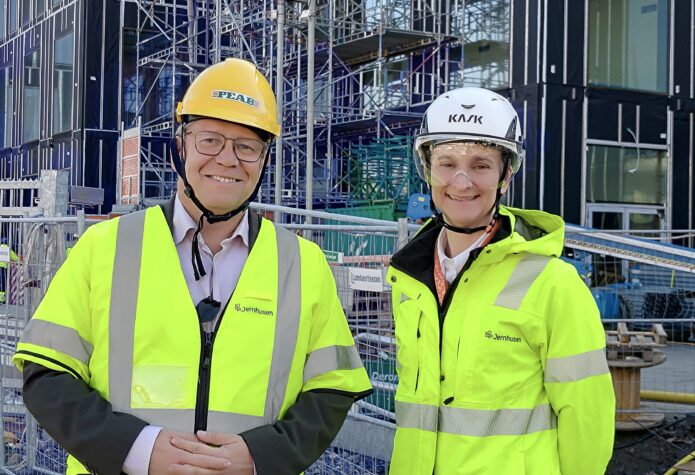
Together with the bank’s Tore Emanuelsson, she is standing beneath the magnificent dome of the Grand Central station building.
“NIB has signed a credit agreement of 1.5 billion with Jernhusen because the projects deliver substantial and measurable productivity gains for the railway system, meet the highest possible climate requirements and draw on NIB’s unique strength: long-term, green financing of socially critical infrastructure,” says Tore Emanuelsson, senior banker at NIB.
They are standing — figuratively and physically — directly on the roof of the tunnel. One of the project’s biggest technical challenges.
“It demands extreme precision in load management. In some sections, for example, we have chosen a timber frame to keep the weight down,” says Caroline Martin.
The area around and to the north of Gothenburg’s Central Station is set to undergo a major transformation. To the east, the land has long resembled a field of forgotten possibilities. Around the railway embankment running east from the central station lie large stretches of central land that have not yet been used to their full potential. Two centuries ago this was a marshy area of reeds and clay. During the 1800s the ground was filled in and plans were forged. Gothenburg Central Station became the country’s first, and the city’s pulse — the bustle, the cafés and the shopping districts — became concentrated around Brunnsparken to the west of the station. Meanwhile the area to the east lay quiet and still, given over to logistics, freight handling and parking. The two station and office buildings are now the starting point for something new. In this new city district, six tall buildings in four blocks are initially planned, for example, situated between the existing central station and Park Central and Grand Central.
“In Gothenburg there is still centrally located land available for development,” says Caroline Martin, referring to possible development to the east.
Outside the building, the sun has finally returned after hiding away during the early weeks of spring. Right next to the construction site, vehicles flow along the main road into the city centre, and people walk briskly with purposeful steps towards the station. Here you have to watch out for buses turning sharply out of the bus terminal. The Grand Central building is finished in a soft yellow tone. Caroline Martin pauses in a narrow passage beside the building.
“Look here at the bricks. The entire façade of Grand Central is made of reclaimed bricks. They were made long ago and were once part of other buildings.”
The lowest possible climate footprint has been the focus throughout design and construction. The office floors of both buildings are to be certified to BREEAM Outstanding, and the ground floors to BREEAM Excellent. Among the materials used are ECO-concrete, reclaimed brick and steel, glazed sections with recycled glass cullet, timber columns, and other materials. Now, during the construction phase, calculations indicate approximately 300 and 360 kg CO2e/GFA respectively for the buildings’ total climate impact from the construction phase.
“The highest energy requirements are harder to achieve at ground level, where the building has many entrances and large open areas,” says Caroline Martin.
The greenhouse gas emission intensity from the project’s energy use has been calculated at approximately three kilograms of carbon dioxide equivalents per square metre per year, considerably lower than NIB’s climate target for commercial properties, which stands at 6.2 kgCO2e/m² per year.
“It is not common for a project to be so far below our target right from the start. It does happen, but it is not common,” says Tore Emanuelsson.
Facts: Grand Central and Park Central
The Grand Central station building, sitting above Centralen station on the Västlänken commuter rail tunnel, contains a hall with retail, cafés and restaurants, as well as office space on the upper floors. The investment amounts to approximately SEK 1.3 billion.
The Park Central project comprises a seven-storey building containing the easternmost of the three exits from Västlänken’s Centralen station, together with offices, service areas and commercial premises. The investment cost for Park Central amounts to approximately SEK 2.2 billion.
NIB has contributed to the financing with a loan of SEK 1.5 billion. Grand Central is owned by Jernhusen, while Park Central is jointly owned by Jernhusen and NCC, with Jernhusen acquiring the property in its entirety upon completion.
Both buildings will open to passengers in December 2026 and will be fully completed during 2027.
Kaj 16 — a modern timber office building in central Gothenburg
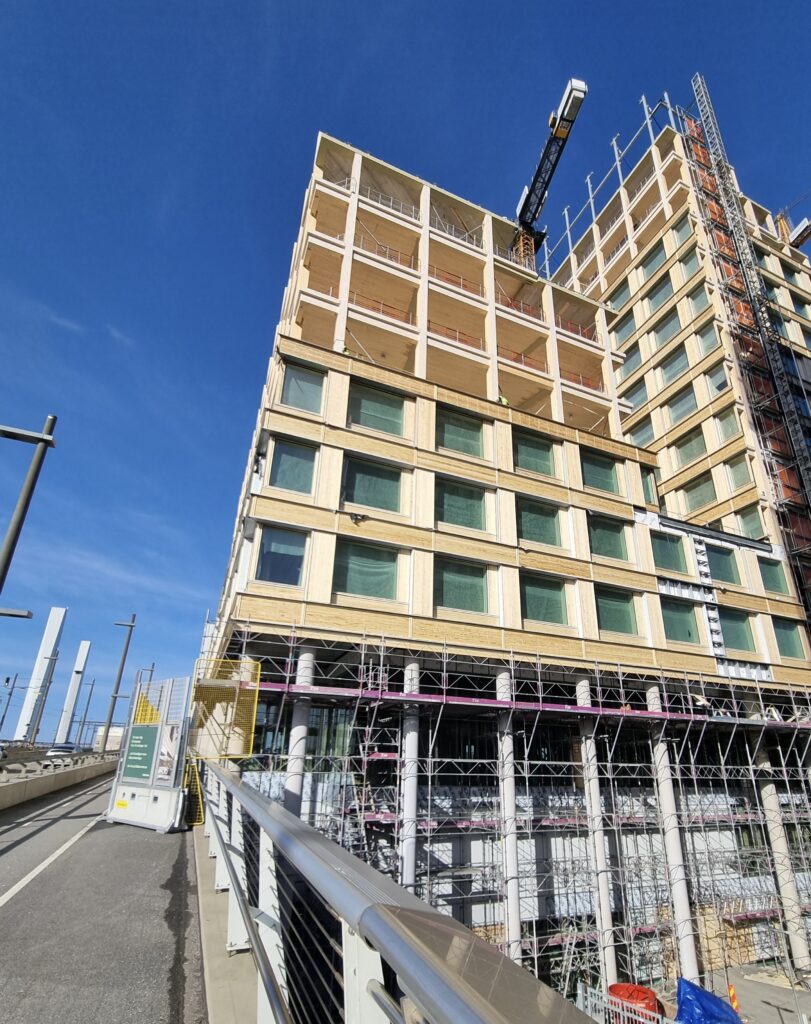
Beside the river, at the foot of the Hisingen Bridge in Gothenburg, a 16-storey office building is rising, constructed largely from reclaimed timber and concrete. Vasakronan’s 30,000-square-metre building helps to expand and densify the city centre along the river and around the central station. Its design — with the four lowest floors in concrete and the remaining twelve in timber — connects to an old Gothenburg tradition: the so-called landshövdingehus (“governor’s houses”). These workers’ dwellings, found across Gothenburg’s neighbourhoods, have a ground floor of stone or concrete, with the two upper floors and attic storage in timber. NIB is contributing to the financing — as it did for the Hisingen Bridge — in this case with a SEK 1 billion loan to Kaj 16.
When the largest tenant, the staff of the bank SEB, move in, they will be greeted by an environment in which circular construction methods have been used. The project is being built within NIB’s climate targets, is designed in line with the EU Taxonomy for energy class A, and is aiming for LEED Platinum certification. The concrete comes from the previous building on the site and from other demolished buildings.
Located near the Göta River, climate risks such as flooding and storms are managed through a foundation 2.8 metres above sea level. Critical technical systems are placed on the third floor, and heavy rainfall is dealt with by green roofs equipped with infiltration systems and detention basins. The building’s solar panels are expected to generate around 100 MWh of electricity per year, and the cooling system is designed to reduce energy consumption. The first occupants are scheduled to move in in mid-2027.